Saudi Defense Minister Arrives in Tehran to Test Mecca Pact
The visit marks the first high-level implementation of the August security alliance, which includes a collective defense clause.
By Javier Cabrera ·
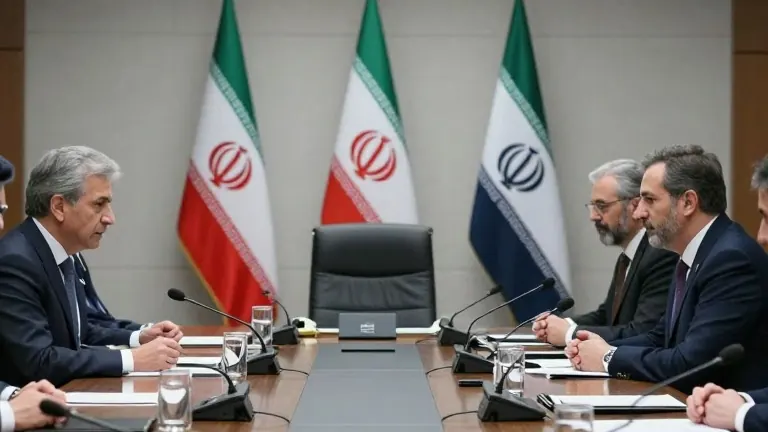
Saudi Arabia’s Defense Minister Khalid bin Salman landed in Tehran on October 26 to meet with Iranian officials. This visit serves as the first practical test of the Mecca Joint Defense Agreement, a security pact signed in August that links Riyadh with Ankara and Islamabad.
The delegation includes Pakistan’s army chief, Field Marshal Asim Munir, and Turkish Intelligence Head Ibrahim Kalin. Their presence signals that the three nations are seeking concrete mechanisms for cooperation rather than just symbolic gestures. Critics have long questioned whether the pact has enough force to compel member states to act during a crisis.
Iranian Foreign Ministry Spokesperson Esmaeil Baghaei described the meeting as a key step in regional diplomacy. He stated that hosting senior military and security officials from the three member states could help achieve lasting stability in the Middle East. Baghaei argued that the region can only secure this stability through direct cooperation among its major powers.
The timing of the talks coincides with ongoing conflict between Iran and the United States. Both Washington and Jerusalem have openly stated that the war will continue. President Donald Trump has twice endorsed Israeli Prime Minister Benjamin Netanyahu’s leadership, suggesting that the U.S. requires a specific partner in Israel to coordinate military operations against Iran.
Many Israelis view the alliance between the two nations as extending beyond individual leaders. They generally agree on the need to confront the Iranian regime. Reports from Jerusalem indicate that the Israeli military was hesitant to launch strikes immediately before recent elections. The arrival of high-level delegations from Saudi Arabia, Turkey, and Pakistan suggests that these countries believe a brief pause in hostilities is possible.
Observers note that the Mecca pact may function more like a diplomatic forum than a traditional military alliance. The agreement emphasizes shared interests and consensus building. This approach mirrors the historical function of NATO, which has prioritized joint training and operational sharing over frequent engagement in large-scale wars since its founding in 1949.
The member states of the new pact exhibit cautious military doctrines. Saudi Arabia operates as a conservative monarchy that typically avoids rapid escalation. Turkey reduced its military activity after the period of 2016 to 2022. Pakistan, despite recent clashes with neighbors, maintains a conservative posture compared to previous decades. These factors suggest the alliance is designed to manage tensions rather than launch immediate offensives.
The Mecca Joint Defense Agreement was signed on August 7, 2026, in Mecca by Saudi Crown Prince Mohammed bin Salman, Turkish President Recep Tayyip Erdogan, and Pakistani Prime Minister Shehbaz Sharif. The text includes a collective defense clause stating that an armed attack on one member is an attack on all three. It also mandates expanded military cooperation, joint exercises, intelligence sharing, and defense technology development.
The alliance brings together three major military powers, including nuclear-armed Pakistan and NATO member Turkey. A Strategic Political and Defense Committee was established to coordinate these efforts. Turkey published the full text of the agreement in October as it moved toward parliamentary ratification.
Saudi Arabia’s Deputy Minister for Public Diplomacy, Dr. Rayed Krimly, said the talks are part of ongoing efforts to de-escalate the current situation. The meeting will be held with Iranian President Masoud Pezeshkian and Mohsen Rezaei, the Secretary-General of the Supreme National Security Council. Riyadh views these diplomatic channels as essential to encouraging dialogue and finding solutions to regional tensions.
Source: The Jerusalem Post