Moscow's Data: Pyongyang Mass-Produces Drones
North Korea has begun large-scale drone manufacturing and improved missile accuracy using Russian military data, prompting Seoul to test its first hypersonic missile.
By Amelia Clarke ·
North Korea has started mass-producing attack drones and refining the accuracy of its ballistic missiles, a capability boost driven by data exchanges with Russia. The New York Times reported that Pyongyang is leveraging its partnership with Moscow to modernize its arsenal, trading soldiers and workers for military technology. This shift marks a departure from previous trends, where Seoul typically issued short statements after North Korean missile tests. Instead, the South recently conducted its first hypersonic ballistic missile test in response.
The diplomatic and military alignment deepened after Russia’s full-scale invasion of Ukraine. Since then, Moscow has shared deployment data and feedback with Pyongyang. Analyst Anton Ponomarenko stated that this information has helped North Korea improve the maneuverability and precision of its weapons. He described the resulting threat to South Korea as more substantial. In June 2026, North Korea announced tests of a modernized 240mm multiple-launch rocket system, a tactical ballistic missile, and a 155mm long-range artillery shell. In August, Russia requested KN-30 ballistic missiles from its ally.
The latest escalation began in early October. Pyongyang tested a tactical ballistic missile it claimed could carry a nuclear payload. South Korea and Japan estimated the missile traveled approximately 700 km, while North Korea asserted a range of 1,000 km. Five days later, South Korean President Lee Jae Myung observed the launch of a hypersonic ballistic missile. The New York Times characterized this test as a sign of growing unease in Seoul regarding the rapid advancement of North Korean missile technology. The South Korean government moved quickly to demonstrate its own defensive and offensive capabilities.
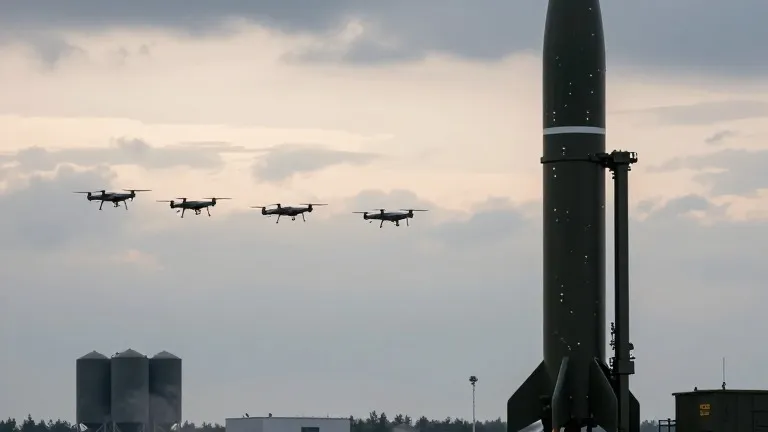
Russia has also assisted North Korea in building unmanned systems. The New York Times noted that Pyongyang studied drone usage in Ukraine and the Middle East, where inexpensive aircraft overwhelmed expensive air defense networks. Last month, North Korea conducted a drill in which a drone swarm attacked a target island simultaneously with cruise and ballistic missile strikes. This combined tactic illustrates how the two nations are integrating low-cost volume attacks with high-precision strikes. The New York Times argued that these evolving methods will force South Korea and its allies to redesign their air defenses at high cost.
The partnership extends to labor and production facilities in Russia. Bloomberg reported in September that up to 25,000 North Korean citizens are working at military plants in Alabuga, Tatarstan, producing drones. Additionally, a North Korean missile unit is deploying in western Russia. This unit is equipped with 120 ballistic missiles and six launchers for potential strikes against Ukraine. The exchange of human capital for military hardware continues to define the strategic relationship between the two nations.
South Korea’s recent hypersonic missile test signals a strategic adjustment. The move aims to counter the improved accuracy and volume of North Korean weapons. The integration of Russian data into North Korean systems has narrowed the technological gap between the two Koreas. As North Korea scales up drone production, the defensive burden on South Korea and its allies increases. The specific costs of redesigning air defense systems remain a point of analysis among regional experts.
The next phase of this dynamic involves continued testing and deployment. North Korea is expected to conduct further missile trials, while South Korea monitors the integration of new Russian technology. The presence of North Korean workers in Russia ensures a steady flow of intelligence and technical feedback. This cycle of testing, data sharing, and response defines the current state of the peninsula’s military balance.
Source: Ukrainska Pravda