Fourteen Years After Sandy, Rockaway Faces New Flood Threats
Oceanside dunes are near completion, but bayside flood protections remain in the design phase as routine high-tide flooding worsens for residents.
By Owen Turner ·
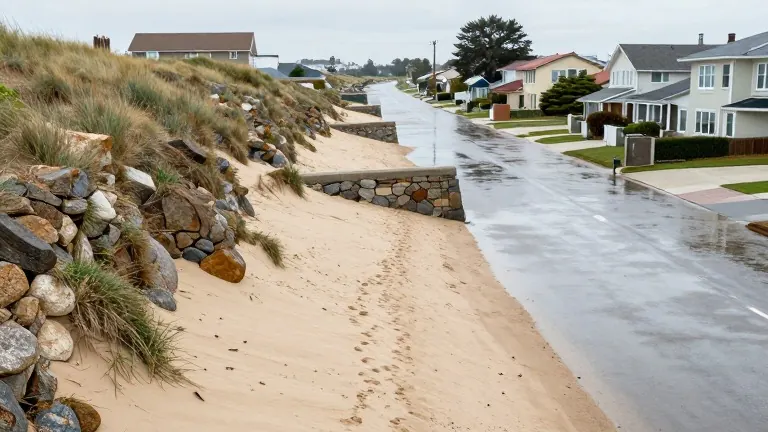
Residents of Rockaway face a different set of flood risks fourteen years after Hurricane Sandy. While the beachfront has been hardened, many neighborhoods on the Jamaica Bay side still suffer from routine water intrusion during heavy rain and high tides.
The U.S. Army Corps of Engineers has completed major work on the ocean side. Approximately 3.5 million cubic yards of sand were restored to the beach after Sandy displaced 1.5 million cubic yards. Stone groins were finished in 2024, and a cement boardwalk was completed in 2017. The current reinforced dune project, which uses armor stone and sheet pile walls to block storm surge, is scheduled for final completion in late 2026.
However, the bayside remains vulnerable. In September 2026, a nor’easter stripped sand from the western end of the beach, leaving a 10-foot cliff in some areas. Brett Branco, executive director of the Science and Resilience Institute at Jamaica Bay, noted that keeping sand in place is difficult. He explained that high-energy waves cause permanent or temporary beach loss, making protective structures essential.
The Corps stated that a layered approach is needed to address both oceanside and bayside flooding. They said the completed oceanside improvements are designed to reduce wave effects and overtopping during major storms. Yet, they acknowledged that no system can eliminate all flooding, especially from low-frequency storms beyond design conditions.
Bayside construction has not started. The Corps originally projected construction would begin in 2025. According to a fact sheet released in July 2026, the mid-Rockaway portion is at a 30% design milestone. The project is currently in the design, coordination, and approval phase. The Corps said the team is refining alignment and resolving permitting details before construction can begin.
Jeanne DuPont, executive director of RISE, expressed concern about the timeline. She said there is no end in sight for the ocean project, let alone the bayside work. RISE launched a coastal resilience plan in 2020 to restore dunes between Beach 17th and Beach 76th streets. Residents employed by the group have planted native species to stabilize the dunes.
In Edgemere, the Edgemere Alliance and Garden by the Bay announced on Oct. 27 that $2.5 million was allocated for a seawall on Beach 43rd Street. The project includes berms and nature-integrated elements to protect against bayside flooding. Branco said these local efforts are crucial for addressing resident needs while preserving the environment.
Source: Rockaway Times