30-Degree Plunge in 10 Minutes Explains Mars' 1,000-Mile Cloud
A new model from Sorbonne Université suggests the Arsia Mons cloud forms via a freezing process requiring humidity levels 100,000 times greater than Earth's.
By Owen Turner ·
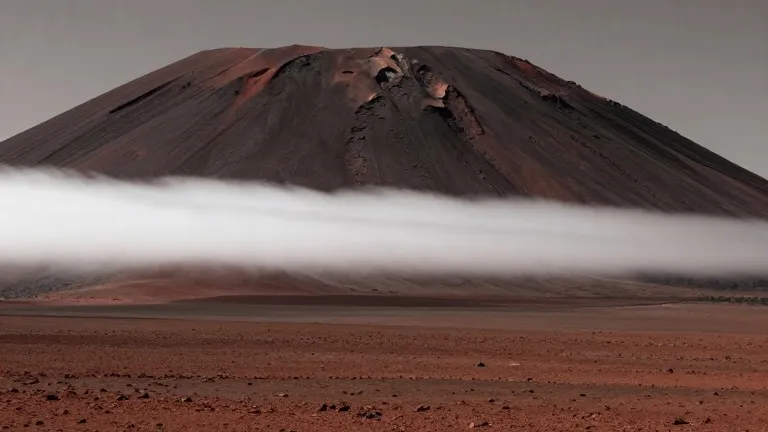
A temperature drop of 30 degrees Celsius within ten minutes drives the formation of a Martian cloud stretching over 1,000 miles. This extreme rate of cooling is the key variable in a new modeling study that successfully reproduces the daily appearance and disappearance of the feature. The work resolves a mystery that has persisted since a probe first recorded the phenomenon in 2018.
The Arsia Mons Elongated Cloud, or AMEC, appears during Martian spring and summer. It grows in length through the morning until it spans a distance comparable to the straight-line route from New York to Kansas City. The cloud then dissipates, and the cycle repeats over several months. The new study, published in Nature Geoscience, is the first to replicate this behavior in a simulation.
Jorge Hernández-Bernal, a planetary scientist at Sorbonne Université in Paris, led the research team. He stated that the simulations only worked after the team included what he termed "exotic physics." This specific physical process appears in textbooks but is generally treated as theoretical, with scientists assuming it rarely occurs in nature. "Once we included this physics in our simulations, the AMEC emerged just as we hoped," Hernández-Bernal said in a press release.
The model proposes that the cloud forms through homogeneous nucleation. In this process, vapor turns directly into ice crystals without the need for dust or salt particles to seed the formation. On Earth, clouds typically form when water vapor condenses around such debris. Hernández-Bernal compared the Martian process to droplets of condensation appearing in the middle of a room rather than on a window. He described the mechanism as "wholly unexpected."
The 65,000-foot volcano Arsia Mons creates the conditions necessary for this reaction. When wind strikes the peak, it generates a powerful wave that lifts moist air high into the atmosphere within minutes. This rapid ascent causes the necessary temperature plunge. The process requires high relative humidity, a condition previously unknown to exist on Mars at these levels.
The humidity required for homogeneous nucleation is more than 100,000 times greater than any value measured on Earth. This extreme threshold may explain why the process has never been directly observed in the upper atmospheres of Venus or Earth, despite long-standing scientific assumptions that it could occur there. Far less is known about the Martian atmosphere than Earth's, making the successful reproduction of the cloud a distinct achievement. "The result is remarkable," Hernández-Bernal noted.
Source: Wired