140 Kyiv Residents Dead in First Eight Months of 2026
With subway stations serving as makeshift dorms for thousands, the capital's casualty rate has already outpaced the entire previous year.
By Owen Turner ·
Fourteen hundred people have been killed in Kyiv since January 2026. The city’s military administration reports that this toll reached 140 in the first eight months of the year. That figure already exceeds the 172 deaths recorded across all of 2025.
The pace of casualties suggests 2026 could become the deadliest year for the capital since the full-scale invasion began in 2022. Russian attacks on the city have intensified, shifting the urban experience from a rear-area routine to one resembling a front-line zone.
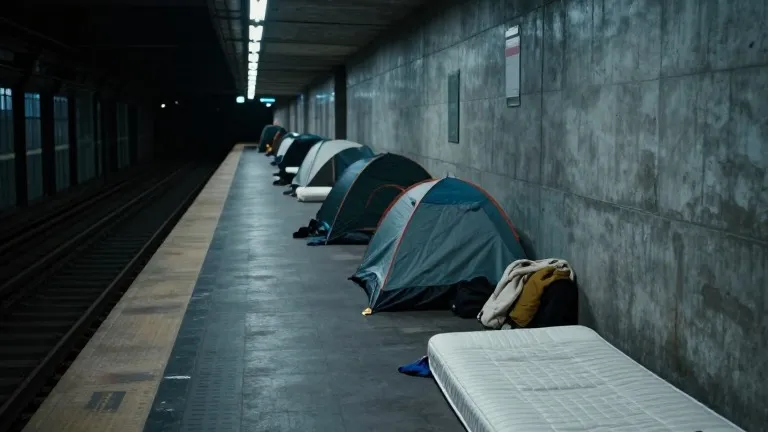
With only limited shelter capacity for a population of four million, many residents have moved their living quarters underground. Subway stations now host thousands of people who lay out mattresses and set up small tents each night. Children and pets rest along the cold walls, turning the transit hubs into improvised dormitories.
Halyna, a resident of the Lukyanivka district, takes her five-year-old son Roman to the nearest station most evenings, even when no siren sounds. She told Deutsche Welle that the family has been fortunate to survive thus far. "We're alive," she said. "We've been lucky once again." Her district has faced repeated targeting during the four years and eight months of conflict.
Strikes have also claimed young lives. In September, a Russian drone hit an apartment building in the central Pechersk district. Daniel Umanskyj, 14, was in his room doing homework when the impact occurred. A neighbor named Vlad was in the hallway with his daughter at the time. He said their late arrival that day saved their lives. "These sick monsters don't care who they kill," Vlad said. Flowers now mark the damaged building in Daniel's memory.
Educational institutions have come under fire as well. In early October, a drone struck a school building in southwestern Kyiv. Principal Valentyna Chorna stated that the school continued in-person classes for students in grades one through nine because its shelter could hold more than 500 pupils. Teachers and students were already in the shelter when the strike landed.
The decision to hold classes depends on shelter availability and the duration of sirens. Parents face additional strain when alarms sound during the morning. A colleague at Deutsche Welle's Kyiv bureau noted that walking to school carries risk because alerts can begin at any moment. Her daughter attends a school near the Antonov aircraft factory, and a drone struck their own building in September without causing damage to the apartment.
Infrastructure damage has disrupted daily logistics. Strikes on warehouses have led to supermarket shortages not seen since the early months of the war. Emergency power outages returned in late September, and a Russian attack paralyzed the subway system. With energy infrastructure under fire, the city faces uncertainty regarding the reliability of heat, electricity, and water supply during the upcoming winter.
Residents report a high level of endurance. A survey by the Kyiv International Institute of Sociology conducted in September found that 72% of city residents are prepared to endure the war for as long as necessary. Local authorities have adjusted routines to maintain order. The curfew now runs from 1 a.m. to 5 a.m. Some facilities may operate during yellow alerts, while red alerts, which signal ballistic or cruise missiles or large combined attacks, require immediate sheltering.
Source: Deutsche Welle