Crows process visual choices at double the speed of primates
New research reveals that crows utilize identical neural accumulation strategies as monkeys but reach final decisions with significantly greater rapidity.
By Amelia Clarke ·
Two times faster. That is the primary speed advantage crows hold over primates when processing ambiguous visual data, according to a study released this week. The finding challenges long-standing assumptions about the structural requirements for rapid decision-making in the animal kingdom. By demonstrating that birds reach conclusions at twice the pace of their mammalian counterparts, the research highlights a surprising efficiency in avian cognition despite significant anatomical differences.
The core of the inquiry centers on how brains integrate weak sensory signals into definitive actions. Scientists have long relied on a specific visual test to map this process in primates. In that standard protocol, subjects observe a cloud of flickering particles that drift slightly in a particular direction. The animal must determine the trajectory and commit to a choice. In monkeys, this procedure reveals that neurons in the neocortex accumulate evidence until firing rates cross a specific threshold, triggering the final decision.
However, birds lack a neocortex entirely, leaving a gap in scientific understanding regarding how their differently organized brains handle similar cognitive loads. Andreas Nieder, a neurobiologist at the University of Tübingen, described this structural disparity as the central puzzle. He noted that the field needed to understand how a brain without this specific region could encode complex decisions. This gap motivated the new experimental design, which sought to bridge the evolutionary divide between avian and primate neural processing.
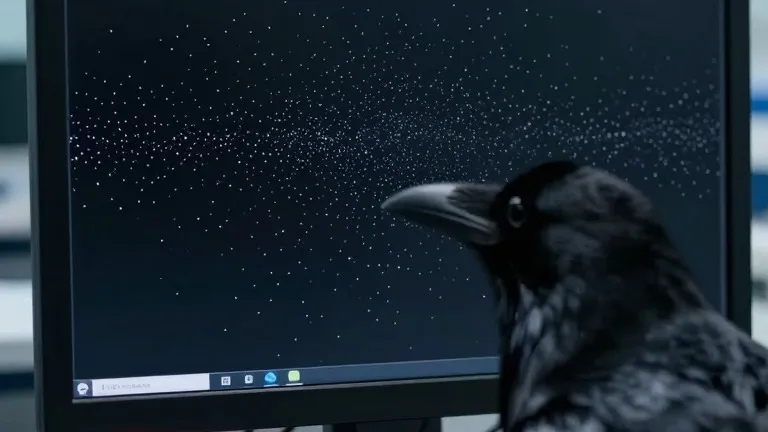
To address the question, Nieder and colleague Philipp Schmidbauer subjected two hand-raised carrion crows to a version of the standard visual task. The birds faced a touch-sensitive monitor displaying white specks against a dark background. A subset of these dots moved coherently in one of four cardinal directions. The crows indicated their perception by pecking at specific targets located beside the screen. A successful identification rewarded the bird with a mealworm, reinforcing the behavioral response.
The team maintained strict parity between the bird and monkey experiments to isolate the effect of brain structure. Nieder emphasized that the stimulus parameters remained identical across both species. The only mechanical difference involved the method of response. While primates typically signal their choice through eye movements, the crows used pecking. This controlled variable allowed researchers to attribute performance differences directly to neural architecture rather than task variations.
Difficulty was adjusted by modifying the proportion of dots moving in unison. The spectrum ranged from a high of 81 percent coherent motion, which is easily detected, down to 3 percent, which is nearly indistinguishable from random noise. A condition with zero coherent motion was also included to test baseline guessing rates. Across these varying levels of ambiguity, the crows demonstrated the same mathematical logic used by primates to integrate evidence over time.
The results confirm that the absence of a neocortex does not hinder the ability to perform complex probabilistic reasoning. Instead, the avian brain achieves comparable accuracy while operating at double the speed. This suggests that alternative neural structures can evolve to process information with greater temporal efficiency, offering new insights into the diversity of cognitive strategies across species.
Source: Ars Technica