Artemis III: NASA outlines 14-day orbital test involving three rockets
The agency will launch New Glenn, SLS, and Starship to validate lander systems before a planned 2028 lunar landing.
By Amelia Clarke ·
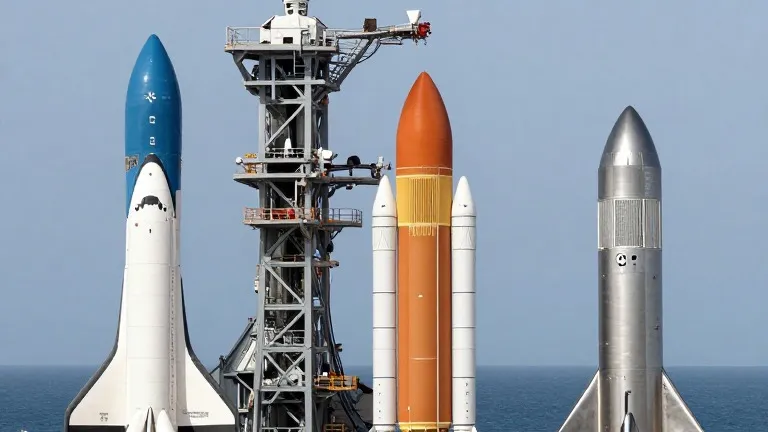
NASA has finalized the operational plan for Artemis III, a complex orbital mission intended to verify commercial lunar landing systems.
Program manager Jeremy Parsons described the upcoming campaign as likely the most complicated launch sequence in history, involving three distinct heavy-lift vehicles.
The test flight is designed to qualify hardware for the 2028 Artemis IV mission, which aims to place astronauts near the moon's south pole.
The sequence begins with Blue Origin's New Glenn rocket carrying the Blue Moon lander into low Earth orbit.
NASA's Space Launch System will subsequently launch the four-crew Orion spacecraft, including astronauts Randy Bresnik, Andre Douglas, and Frank Rubio, along with ESA's Luca Parmitano.
Orion will initially enter a highly elliptical orbit with altitudes ranging from 18 miles to 1,122 miles.
The spacecraft will then adjust to a circular orbit of approximately 345 miles to stabilize thermal conditions.
On Flight Day 3, the crew will dock with Blue Moon at an altitude of 273 miles.
Astronauts will spend two days inside the lander to test environmental controls, life support systems, and emergency protocols.
SpaceX's Starship is scheduled to launch around Flight Day 6 with a specialized docking adapter.
The vehicle will meet Orion on Flight Day 8 at an altitude of 237 miles for a brief two-hour docking test.
The crew will not enter Starship during this phase, but engineers will measure docking forces and interaction dynamics between the vehicles undocking and re-ignition of the 171-foot upper stage will also be monitored during this encounter, according to Parsons. After undocking from Starship, Orion will complete a 14-day nominal mission that could extend to 17 days before an ocean splashdown. The crew will use this time to evaluate survival suits, conduct health assessments, and perform technology demonstrations. NASA administrator Jared Isaacman stated that the agency is preserving options for both commercial partners to ensure readiness for the 2028 landing. Isaacman noted that neither provider has been selected for the crewed lunar touchdown yet. He added that NASA has no intention of surrendering a viable path to the surface before data and schedule compels such a decision. Both Blue Origin and SpaceX are currently planning lunar landing missions for 2028, though their operational profiles differ significantly regarding where the spacecraft will dock. NASA is targeting a summer launch window for Artemis III, although an internal memo indicated the mission is currently about 90 days behind schedule. Parsons identified the lunar lander supply chain as a primary challenge in meeting this timeline.
Source: Space.com